Dabbed Behind the Ear: The Forgotten Power Move That Made Pin-Up Legends Untouchable
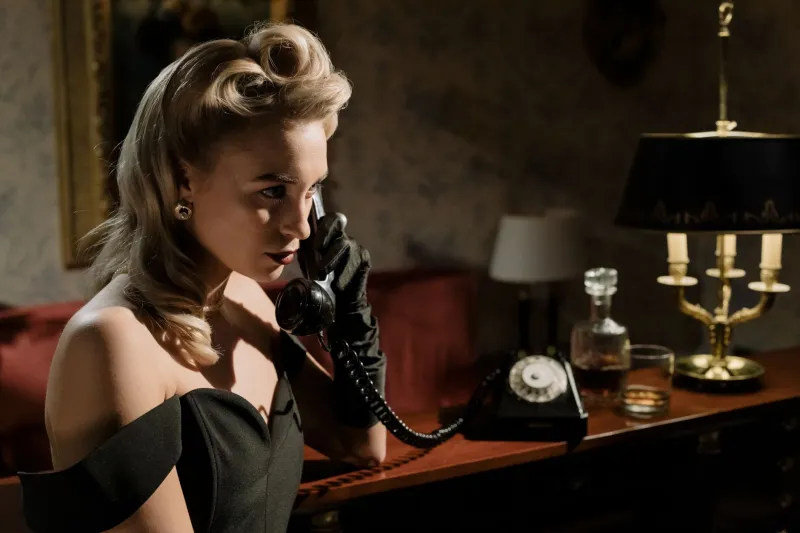
There's a moment in almost every old Hollywood story where a woman walks into a room and something shifts. The lighting hasn't changed. The music hasn't swelled. But suddenly, everyone is paying attention. For decades, that moment got credited to the dress, the hair, the smile. Almost nobody talked about what was drifting invisibly through the air ahead of her.
Perfume was never just perfume. Not for the women who understood what they were doing.
The Original Personal Brand Nobody Documented
We throw the phrase "personal brand" around like it was invented somewhere between Instagram and LinkedIn. But the pin-up performers and Hollywood starlets of the 1940s and '50s were running sophisticated identity operations long before the vocabulary existed to describe them. Scent was a cornerstone of that strategy — and it worked precisely because it operated below conscious awareness.
The psychology behind this is well-established now, even if it wasn't articulated in those terms back then. Smell is processed by the olfactory bulb, which has a direct line to the limbic system — the part of the brain that handles emotion and memory. A fragrance doesn't just register; it attaches. It becomes inseparable from the person wearing it. Walk into a room three weeks later wearing the same scent, and you've already primed every person who remembers it to feel exactly what they felt the first time they met you.
The savvy women of the Golden Age pin-up era figured this out through instinct, observation, and hard-won experience in rooms that were rarely designed with their best interests in mind.
Choosing a Signature Wasn't Casual
In an era when a handful of French houses dominated the fragrance market and American women were just beginning to have their own disposable income, choosing a perfume was a statement with real cultural weight. Chanel No. 5 wasn't just a scent — it was a signal. So was Shalimar. So was Joy by Jean Patou, which was marketed as the costliest perfume in the world and made sure you knew it.
For pin-up performers navigating the complicated social ecosystem of studios, photographers, agents, and clients, the choice of fragrance carried layered meaning. A heavy oriental base — amber, musk, sandalwood — communicated something very different from a fresh floral or a crisp citrus. Women who understood the game chose deliberately. Some went for the aspirational European luxury of a French house. Others sought out American perfumers whose more accessible price points still carried significant glamour in a postwar economy where conspicuous consumption was making a furious comeback.
The real power move wasn't just wearing one scent. It was owning one scent. Never deviating. Making it so consistently associated with you that the people you worked with — photographers, magazine editors, the men writing the checks — began to anticipate your presence before you arrived. Anticipation is influence. Influence is leverage.
Negotiation Rooms and Invisible Advantages
Here's where it gets interesting, and where the history gets deliberately vague. The entertainment industry of the 1940s and '50s was not a level playing field. Women in pin-up and adjacent spaces — burlesque, modeling, early men's magazine work — were operating with limited formal power and had to be creative about the informal kind.
Multiple accounts from performers of that era, preserved in memoirs, interviews, and the occasional oral history project, describe a calculated approach to physical presence in professional settings. What you wore, how you moved, what you smelled like — these weren't vanity concerns. They were tools. A woman who could walk into a contract negotiation radiating a scent that her client had come to associate with pleasure, with desirability, with the version of himself he liked best, had shifted the dynamic before a single word was spoken.
This wasn't manipulation in any cynical sense. It was sophisticated self-presentation by women who had learned, through necessity, to work every available angle. The perfume was the least aggressive weapon in the arsenal — and often the most effective.
What Modern Performers Figured Out
Fast forward to the digital era, and the dynamic has changed dramatically in some ways while staying remarkably consistent in others. Today's pin-up-influenced performers — whether they're running subscription content platforms, booking shoots, or building lifestyle brands — are operating in a landscape where most of their audience interaction happens through a screen. You can't pipe your signature scent through someone's phone.
But the underlying principle hasn't gone anywhere. What the perfume accomplished in a physical room — creating a sensory anchor, triggering emotional association, building an identity that people could feel rather than just see — that's exactly what today's creators are engineering through other channels. Consistent visual aesthetics. Recurring audio elements. The particular way a creator's feed feels when you scroll through it. These are all olfactory strategy translated into digital language.
And here's what's fascinating: some modern performers are looping back to the original tool entirely. Fragrance partnerships, custom scent collaborations, and "signature scent" reveals have become a genuine content category. A creator who tells her audience this is my perfume, this is what I smell like is doing something ancient and psychologically potent. She's inviting her audience into a sensory relationship that goes beyond the visual. She's making herself real in a way that pixels alone can't accomplish.
The Bottle as Biography
There's one more layer here that tends to get overlooked in conversations about vintage glamour and its modern echoes. The perfume bottle itself was — and remains — a deeply personal object. In the Golden Age, a woman's dressing table was one of the few spaces she could genuinely call her own. The bottles arranged there were a kind of autobiography. What she chose to display, what she actually wore, what she kept hidden — these things told a story about who she was and who she was choosing to be.
For pin-up performers whose public image was so carefully constructed and so thoroughly owned by other people, the private ritual of perfume application was an act of self-determination. You could put on the costume, hit the pose, deliver the smile that sold the magazines. But the scent on your skin was yours. Nobody else chose it. Nobody else wore it. In a professional landscape where so much was negotiated away, that small sovereignty mattered.
The women who turned that sovereignty into strategy — who took the one thing they fully owned and made it work for them in every room they walked into — were doing something quietly radical. They were building power from the inside out, starting with something so intimate it was invisible.
That's a move worth studying. And if you happen to pick up a bottle of something heavy and warm and deliberately unforgettable while you're at it, well. Now you know exactly what you're doing.


