From Bullet Bras to Shoulder Pads: The Decades That Taught America What Sexy Looks Like
Sex appeal has a history. It's not some fixed, eternal thing — it shifts and evolves with the culture, shaped by war and economics and politics and the particular anxieties of any given moment. And nowhere is that more visible than in fashion. The clothes people wore, the silhouettes that were considered desirable, the fabrics that whispered against skin in the dark — these weren't accidents. They were cultural products, loaded with meaning, and they've left a mark on how we think about desire that we're still reckoning with today.
At Pin-Up 682, we spend a lot of time thinking about this stuff. The vintage aesthetic isn't just a look for us — it's a lens. And when you look at the decades from the 1940s through the 1980s through that lens, what you see is a fascinating, sometimes contradictory, always compelling story about what Americans wanted and what they were afraid to want.
Let's take the tour.
The 1940s: Scarcity Made Sexy
World War II did something unexpected to American sexual aesthetics: it made desire patriotic. The pin-up girl — that cheerful, confident, improbably glamorous figure tacked to the walls of barracks and painted on the noses of bombers — was a product of wartime psychology as much as anything else. She represented what the boys were fighting for. She was home, and freedom, and the promise of a future worth surviving for.
But the fashion of the era was shaped by constraint. Fabric rationing meant shorter skirts, fewer pleats, simpler cuts. And paradoxically, those limitations produced some of the most enduringly sexy silhouettes in American fashion history. The high-waisted skirt that hit just below the knee. The fitted jacket with its square shoulders. The seamed stocking that drew the eye up the leg. When you can't show everything, suggestion becomes an art form.
The bullet bra — that aggressively architectural undergarment that gave the era's women their signature silhouette — is maybe the perfect symbol of 1940s sexiness. It was simultaneously prim and provocative, structured and sensual. It said: I am put together, I am in control, and I am absolutely devastating. That combination of composure and heat is why the '40s aesthetic keeps showing up in adult content creation decades later. It's desire with its chin up.
The 1950s: Abundance and Its Discontents
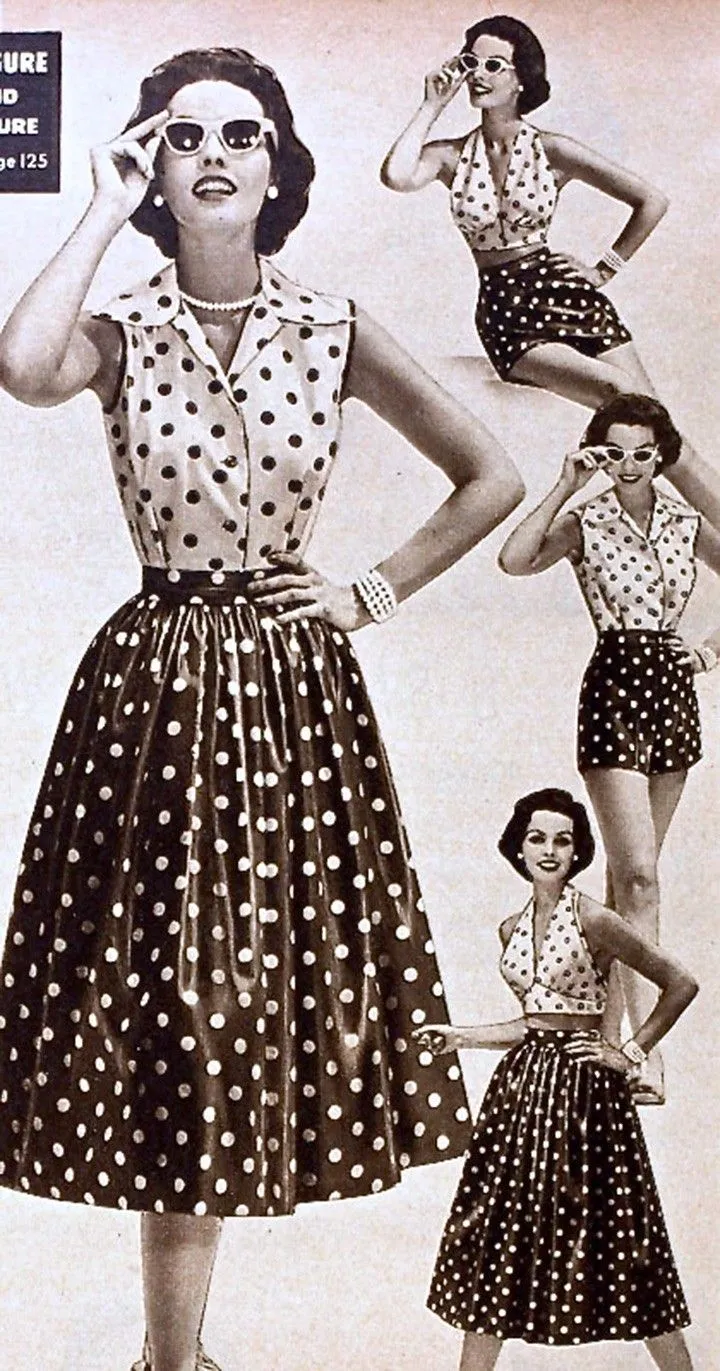
The postwar boom changed everything. Suddenly there was money, there was material, there was a whole consumer economy being built around the idea that Americans deserved nice things. And the fashion of the 1950s reflected that new abundance — full skirts that used yards of fabric just because they could, nipped waists that required serious foundation garments, a general maximalism that was the direct opposite of wartime austerity.
The 1950s pin-up aesthetic is the one most people picture when they hear the phrase at all. It's Bettie Page in a polka-dot bikini. It's a red-lipped woman in a circle skirt caught in a moment of delicious mischief. It's the tension between the era's relentless push toward domesticity and the barely suppressed wildness underneath.
And that tension is exactly why the '50s remain such fertile ground for adult content creators. There's an inherent drama in the gap between the era's surface propriety and its obvious, pulsing desire. The clothes were an elaborate performance of respectability, and great pin-up photography has always understood that the performance is the turn-on.
The 1960s-Early 1970s: When the Rules Broke
If the '50s were about tension, the '60s were about release. The miniskirt. The go-go boot. The shift dress that abandoned the hourglass entirely. Fashion in the 1960s was a declaration of war on the structured, corseted sexiness of the previous decade, and it won decisively.
The early sexual revolution produced a different kind of desirability — one that was about freedom and movement and youth rather than composed, architectural glamour. Hemlines climbed. Bras became optional. The body itself became the statement rather than the clothes that shaped it.
For adult aesthetics, this era introduced something important: the idea that sexy could be playful, even anarchic. The mod girl wasn't trying to be a bombshell — she was too busy having fun. That spirit of joyful, unself-conscious sexuality is another thread that runs through the best contemporary pin-up content, which at its finest manages to be both glamorous and genuinely fun.
The Mid-1970s: Disco and the Body as Temple
Then came disco, and everything got turned up to eleven. The mid-to-late 1970s produced one of the most body-forward fashion moments in American history. Halter tops. Hip-hugger pants. Jumpsuits cut to the navel. Fabrics that moved — silk, satin, Lycra — that clung and shimmered under the lights of Studio 54 and a thousand imitations across the country.
Disco fashion was about display in the most unapologetic sense. The point was to be seen, to be desired, to own the room. The sexiness was extroverted and theatrical — which makes it a natural ancestor of content creation culture, where the performance of desire is literally the product.
The platform shoe deserves its own moment here. Few fashion choices in history have been as purely, deliberately sexual as the platform — it altered posture, lengthened the leg, changed the way a person moved through space. It was architecture in service of desire, and it worked. The platform's enduring presence in adult fashion photography is no accident.
The 1980s: Power, Excess, and the Shoulder Pad as Seduction
The 1980s are the decade that gets the least credit for their contributions to sexual aesthetics, and that's a shame. Yes, there were some crimes against taste. But underneath the hair and the neon, the '80s were doing something genuinely interesting: they were eroticizing power.
The power suit — that broad-shouldered, aggressively tailored garment that women wore to signal their arrival in corporate America — was also, undeniably, sexy. There's a reason the "powerful woman in a suit" remains a persistent fantasy in adult content. The '80s invented that archetype in its modern form.
And then there was the other '80s — the aerobics-and-Lycra '80s, the leg-warmer-and-leotard '80s, the MTV-video '80s. That strand of the decade's aesthetic was all about the body in motion, athletic and available, a very different kind of desire than the composed glamour of the '40s or the theatrical display of the '70s.
Why These Eras Won't Let Us Go
So why do these decades keep showing up in adult content, in pin-up photography, in the aesthetics of desire that creators are building right now? Part of it is simple nostalgia — these eras feel safely distant, wrapped in the warmth of vintage. But I think it goes deeper than that.
Each of these decades produced a distinct and coherent vision of what desire looks like. They had rules — about silhouette, about fabric, about what you showed and what you suggested — and those rules created meaning. A seamed stocking isn't just a stocking; it's a whole vocabulary. A halter top isn't just a top; it's a statement about the body and who it belongs to.
Contemporary adult aesthetics are, by contrast, almost overwhelmingly literal. When everything is available, nothing carries the charge of suggestion. Which is exactly why creators who understand vintage fashion history have an edge: they know how to use clothes as language, how to make desire speak in full sentences rather than just shouting.
The bullet bra and the shoulder pad and the disco jumpsuit aren't just fashion history. They're a masterclass in the grammar of seduction. And at Pin-Up 682, that class is always in session.