The Real Smile: How Pin-Up Learned to Stop Performing Happiness and Start Radiating It
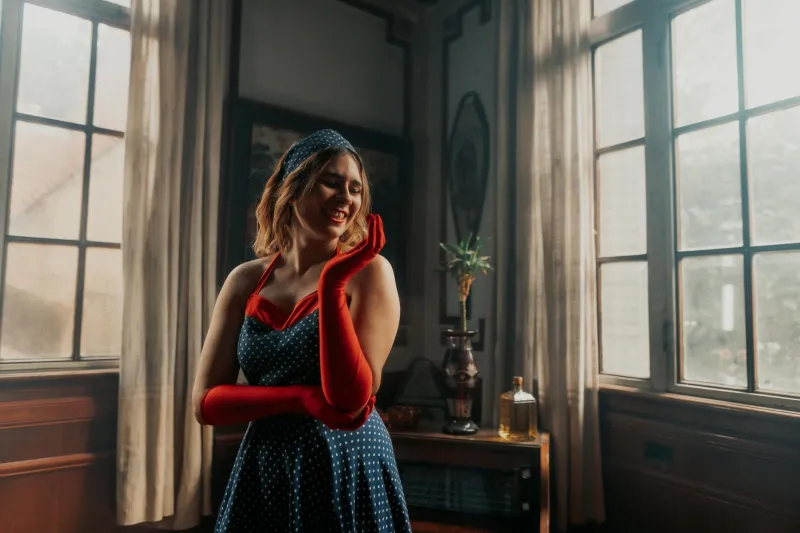
Look at a Vargas illustration from 1945 and you'll see it immediately: that smile.
It's technically flawless. Lips parted just enough, teeth bright, eyes crinkled at the corners in a way that suggests delight without implying effort. It is, in every measurable way, a perfect smile. It is also, in almost every measurable way, completely constructed. Alberto Vargas wasn't painting women — he was painting an idea of women. The smile was part of the fantasy architecture, as deliberate as the lighting and as fictional as the impossible proportions.
For decades, that was fine. Nobody expected pin-up to be documentary. The whole point was the dream.
Then something shifted.
When 'Real' Became the New Standard
Somewhere around the early 2010s — accelerated hard by social media, by the rise of the selfie, by audiences who could now interact directly with the people they admired — the cultural appetite for manufactured perfection started curdling. Viewers didn't just want to look at someone. They wanted to know them. They wanted the imperfect laugh, the candid moment, the smile that arrived because something was actually funny rather than because the shot required one.
For pin-up creators, this created a genuine tension. The aesthetic they were working in — vintage glamour, deliberate styling, composed and considered imagery — is inherently constructed. You don't stumble into a victory roll. You don't accidentally end up in a bullet bra and seamed stockings looking like you just stepped out of a 1955 Esquire spread. Every element is a choice, which means the whole thing is, by definition, a performance.
So how do you perform authenticity? And is that even a coherent thing to ask?
The Manufactured Smile and What It Was Actually Selling
To understand where we are now, it helps to understand what the classic pin-up smile was actually doing.
It wasn't selling happiness. It was selling availability — in the broadest sense of that word. The smile said: I'm here. I'm present. I'm pleased to be seen. It was designed for a relationship between image and viewer that was entirely one-directional. The pin-up didn't have feelings about you specifically, because she didn't know you existed. She existed to be looked at, and the smile was the visual equivalent of a welcome mat.
That model worked beautifully when pin-up lived in magazines and on the walls of airplane hangars and in the back pages of men's publications. The distance between image and audience was the whole point.
Digital platforms collapsed that distance entirely. Suddenly the woman in the image had a comment section. She replied to messages. She remembered your username. The relationship became, at least in part, genuinely reciprocal. And a welcome-mat smile stopped being enough.
Confidence Versus Performance: Where Creators Get Stuck
Here's the trap a lot of creators fall into when they try to thread this needle.
They mistake vulnerability for authenticity. They think that showing the hard day, the bloated afternoon, the moment of self-doubt — that this is what audiences mean when they ask for something real. And sometimes it is. But it's not the whole picture, and it's not particularly compatible with pin-up as a genre.
Pin-up, at its core, is about power. Even in its most playful, most kittenish expressions, it's about a woman who knows she's being watched and has decided to own that completely. The smile in a great pin-up image isn't saying I hope you like me. It's saying I know you do.
That's not manufactured happiness. That's confidence. And confidence, it turns out, reads as completely authentic — because it is authentic. It's just not the kind of authenticity that looks like a therapy session.
The creators who have figured this out are the ones who seem effortless even when they're working hardest. They're not performing joy. They're performing certainty. And certainty, in a media landscape full of people visibly hoping for approval, is genuinely rare. It genuinely lands.
What the Old Icons Actually Had
Go back and look at Bettie Page. Not the manufactured, magazine-ready Bettie — look at the candid shots, the contact sheets, the images where the photographer caught her between poses.
She's still Bettie in all of them. The quality that made her iconic wasn't the pose or the styling, though those helped. It was that she seemed genuinely, fundamentally comfortable in her own skin. The smile in her staged shots and the smile in her candid moments were recognizably the same smile. That continuity — that sense that the image and the person were not in conflict — is what made her feel real even in the most constructed contexts.
That's the model. Not vulnerability. Not manufactured perfection. Continuity between who you are and what you're projecting.
Getting Both Back: A Practical Reframe
If you're a creator wrestling with this — feeling like you have to choose between the glamour you love and the connection your audience wants — here's the reframe that might actually help.
Stop asking whether your smile is authentic. Start asking whether it's earned.
An earned smile is one that comes from a place of genuine confidence in what you're doing — confidence in your styling, your concept, your ability to pull this off. It doesn't have to be spontaneous to be real. A musician who's performed the same song a thousand times can still mean it every single time, because they've done the work to connect with it. Pin-up is no different.
The goal isn't to stop constructing the image. The goal is to construct it so well, from such a place of genuine ownership, that the smile at the end of it isn't a performance of happiness. It's the natural expression of someone who knows exactly what they're doing and loves it.
Vintage glamour and genuine connection were never actually in conflict.
We just forgot that confidence is its own kind of truth.