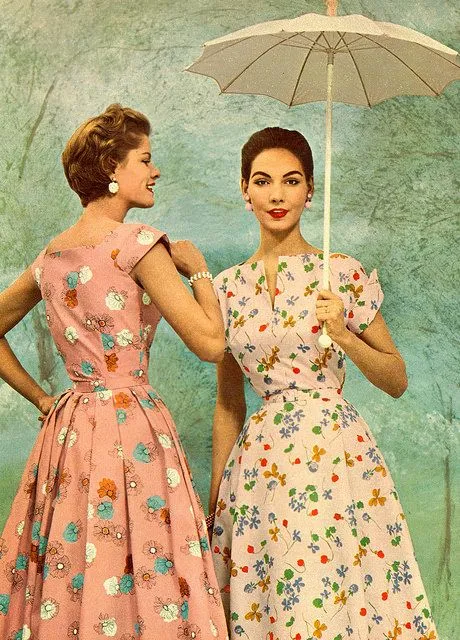
Slow Down, Scroll Less: Why Younger Women Are Trading the Algorithm for Red Lipstick and Retro Curves
Photo: 22quackAA, CC BY-SA 4.0, via Wikimedia Commons
Somewhere between the fourteenth trending audio clip of the week and the third "authentic" skincare routine she'd been paid to post, Dani Reeves hit a wall. The 28-year-old from Nashville had spent three years building a following on TikTok — dance transitions, GRWM videos, fast-fashion hauls — and she was exhausted in a way she couldn't quite explain. "I had 40,000 followers and I felt completely invisible," she says. "Like I was performing for an audience that didn't actually see me."
So she stopped. Deleted the drafts folder. Let the posting schedule lapse. And then, almost on a whim, she bought a vintage-style corset, painted her lips crimson, and asked a photographer friend to shoot her against a plain white wall. The response was immediate — and completely different from anything the algorithm had ever handed her.
"People reached out like they actually wanted to talk to me," Dani says. "Not just double-tap and scroll. There was something about the image that made people stop."
Dani's story isn't unique. Across the country, millennial and Gen-Z women are making a deliberate pivot away from platform-optimized content creation and toward the slower, more intentional world of pin-up aesthetics. It's a movement that's part creative rebellion, part financial recalibration, and part something harder to name — a hunger for imagery that feels genuinely authored rather than generated by trend cycles and engagement metrics.
The Exhaustion Is Real (And the Data Backs It Up)
Let's be clear about what these women are walking away from. The modern influencer pipeline is brutal. Algorithms punish inconsistency. Trends have a half-life of about 72 hours. The aesthetic bar shifts constantly — one month it's clean girl, the next it's mob wife, the next it's something that doesn't even have a name yet. Creators who built audiences around a specific look can watch their engagement crater overnight because the vibe moved on without them.
Pin-up offers the opposite of that. The visual language of 1940s and '50s Americana — the high-waisted silhouettes, the deliberate poses, the emphasis on curves and confidence — doesn't have a trend expiration date. A great pin-up photograph taken today will look just as intentional in five years as it does right now. For women who've spent years chasing the next thing, that kind of stability feels almost radical.
"I was tired of waking up every morning and checking what was trending before I even knew what I wanted to wear," says Marisol Fuentes, a 25-year-old content creator based in Phoenix who shifted her focus to pin-up photography about eighteen months ago. "With pin-up, I already know what I'm doing. The aesthetic is mine. I own it."
Vintage as Visual Autonomy
There's a psychological dimension here that's worth sitting with. Influencer culture, for all its promise of self-expression, is fundamentally reactive. You're always responding to what the platform rewards, what brands want, what the comment section demands. The creator is often the last person in the room making decisions about her own image.
Pin-up flips that dynamic. The genre has always been about deliberate construction — the right lighting, the right angle, the right garment chosen with intention rather than speed. When a woman sits down with a stylist, a photographer, and a vision board full of vintage references, she's not responding to anything. She's initiating. That shift in creative agency is something the women we spoke to described as genuinely transformative.
"I started understanding my body differently," says Reeves. "In the influencer world, I was always trying to minimize something or hide something. In pin-up, I was learning how to present myself in a way that felt powerful. The poses, the lighting — it's all craft. You're not just pointing a phone at yourself and hoping for the best."
That craft component is a significant part of the appeal. Unlike the casual spontaneity that social platforms reward, pin-up photography requires real knowledge — of vintage fashion history, of how to work with a camera, of how to build a mood through wardrobe and setting. Women who dive into the aesthetic often find themselves going deep on research, connecting with dressmakers, learning the difference between a 1940s silhouette and a 1950s one. It becomes a practice, not just a content category.
The Community Nobody Talks About
One thing that consistently surprises women making this shift is the community they find on the other side. Pin-up culture — especially in the US — has a robust network of enthusiasts, photographers, vintage clothing collectors, and event organizers that operates almost entirely outside the major social platforms. There are conventions, local meetups, dedicated online forums, and collaborative shoots that don't require a brand deal or a trending sound to function.
"I found my people," says Fuentes. "And they're not chasing clout. They're just obsessed with the craft. Someone will spend six months tracking down a specific pair of 1950s heels. That level of dedication is something you don't really see in influencer spaces."
For some women, that community has also translated into genuine financial stability — not through sponsorships or affiliate links, but through subscription platforms, print sales, and direct relationships with fans who value the work itself. It's a slower build than going viral, but it's also more durable.
"I make more now than I did when I had four times the followers," Reeves says. "Because the people who follow my pin-up work actually care about it. They're not just there because I showed up in their FYP."
What the Aesthetic Actually Says
It would be easy to read this trend as simple nostalgia — younger women retreating into a romanticized past because the present feels overwhelming. But that reading misses something important. The pin-up aesthetic these women are claiming isn't a passive recreation of the 1950s. It's a reinterpretation — one that keeps the visual glamour while shedding the era's more limiting assumptions about who gets to be desirable and on whose terms.
Modern pin-up shoots feature women of every body type, skin tone, and background. The genre has been expanded and reclaimed by communities it historically excluded. What younger women are borrowing isn't the ideology of postwar America; it's the visual grammar — the confidence, the intentionality, the refusal to be anything other than fully, deliberately present in the frame.
That's not nostalgia. That's a philosophy.
"People ask me why I'm so into something from 70 years ago," says Marisol Fuentes, laughing. "But it doesn't feel like the past to me. It feels like the most forward thing I've ever done."
Dani Reeves is still on social media — she never fully disappeared. But her relationship with it is different now. She posts when she has something worth showing, not when the algorithm demands it. Her audience is smaller than it was at its peak, and she genuinely doesn't care. The work feels like hers in a way it never did before.
"I used to create content," she says. "Now I make images. There's a difference. And once you feel that difference, you can't go back."