Leg Language: The Hidden Vocabulary Woven Into Every Stocking Choice
There's a reason the camera always lingers on the legs.
Not just because legs are beautiful — though they are — but because what's on them is communicating something the rest of the outfit might not be ready to say out loud. Pin-up has always understood this. Long before social media gave creators captions and comment sections, hosiery was doing the heavy lifting. It was shorthand. It was signal. It was, in the most literal sense, coded language you could see from across a room.
Let's decode it.
The Seamed Stocking: Architecture as Aspiration
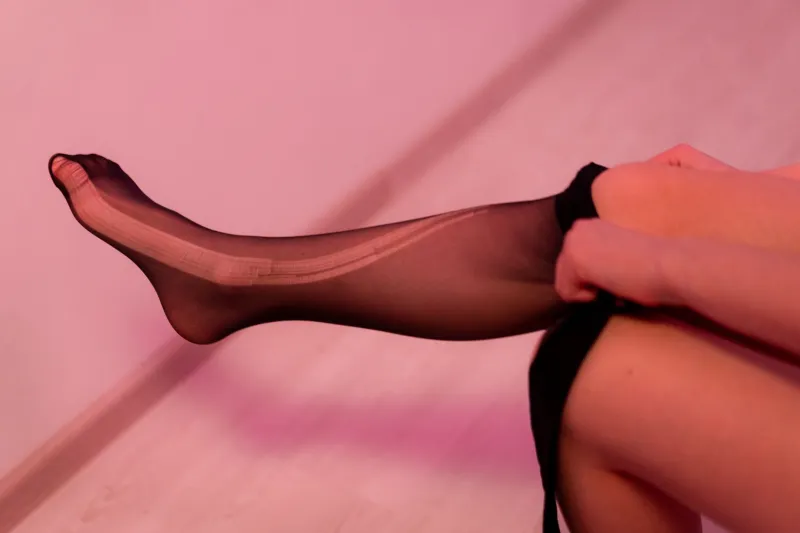
If you want to understand why the seamed stocking became pin-up's founding document, you have to go back to the 1940s, when nylon was rationed and women were literally drawing lines up the backs of their bare legs with eyebrow pencils to fake the look. That's not just fashion history — that's devotion.
The seam itself is a line of intention. It says: I dressed with purpose today. It implies a mirror, a moment of self-examination, a deliberate act of alignment. In the golden era of pin-up illustration — your Vargas girls, your Elvgren beauties — the seam was almost always visible, usually at a slight angle, because perfection wasn't the point. Suggestion was. The seam drew the eye upward. It implied what it didn't show.
Modern creators who reach for seamed stockings are making a very specific choice. They're invoking that whole lineage — the patience, the ritual, the theater of getting dressed. It reads as vintage fluency. And for an audience that can smell inauthenticity from three scrolls away, that fluency matters.
Fishnet: The Rebel in the Lingerie Drawer
Fishnet has never been subtle, and it has never tried to be.
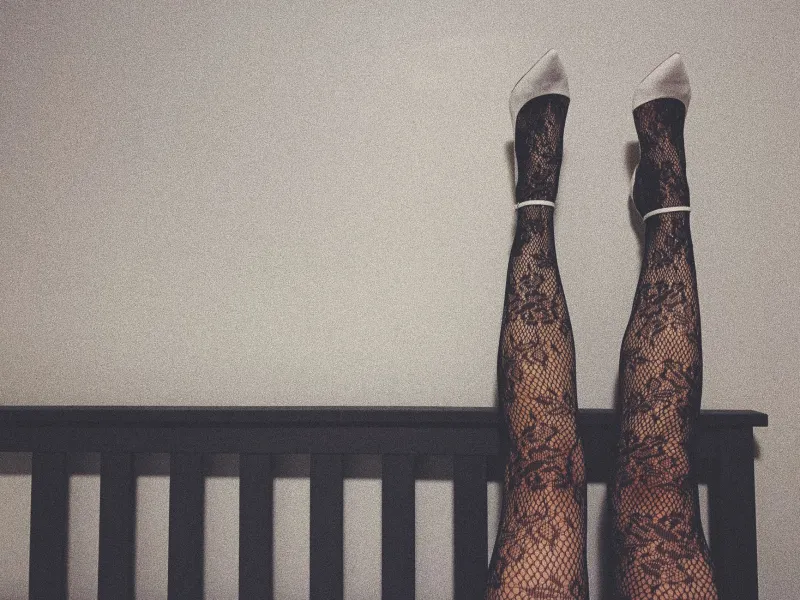
Where seamed stockings whispered, fishnet announced. It arrived in burlesque halls and eventually crawled into the mainstream through rock and roll, punk, and every subculture that needed to signal danger without saying a word. In pin-up terms, fishnet historically occupied a specific lane: it was the choice of the performer, the showgirl, the woman who was very much aware she was being watched and had decided to make that watching her idea.
The grid pattern itself does something interesting to the body. It creates texture where there was none. It maps the skin, breaking it into a repeating geometry that makes the eye work harder, linger longer. There's a reason photographers love it — fishnet interacts with light differently depending on the angle, the gauge of the weave, and what's underneath.
Today, creators are using fishnet in ways that deliberately scramble its old associations. Paired with a demure cardigan and oxfords, it reads as subversion. Layered under a vintage circle skirt, it becomes something almost whimsical. The rebel coding is still there, but it's being wielded with irony and intention — which, honestly, makes it more powerful, not less.
Stay-Ups and Hold-Ups: The Confidence Play
Here's where things get interesting from a semiotics standpoint.
Stay-ups — those stockings with the silicone grip band at the top that require no garter belt — didn't exist in the classic pin-up era. They're a modern invention. And yet they've become enormously popular among contemporary creators, for reasons that go beyond convenience.
The stay-up is a confidence statement. It says: I don't need the infrastructure. No belt, no clips, no complicated rigging underneath. Just the stocking, doing its job on its own terms. For creators who are building a visual identity around self-sufficiency and control — women who are their own directors, their own stylists, their own producers — that subtext lands.
There's also something to be said about the reveal. A garter belt is a whole costume element. A stay-up keeps the mystery intact a little longer. The band at the top is only visible at a certain point, and that point becomes a moment in the narrative. Smart creators know exactly when to let the camera find it.
Opaque Tights: The Counterintuitive Power Move
Nobody talks about this one enough.
Opaque tights — especially in deep colors like burgundy, forest green, or classic black — have been creeping back into pin-up-adjacent content for a few years now, and the choice is doing a lot of work. Where sheer hosiery invites the gaze in, opaque tights redirect it. They create silhouette rather than transparency. They're about shape, not skin.
In an era where so much content competes by showing more, choosing opaque is a form of visual restraint that reads as sophistication. It's the pin-up equivalent of the slow burn. And it connects back to an older tradition — the 1950s sweater girl aesthetic, where suggestion operated through form rather than exposure.
For creators who want to build a brand around tease rather than reveal, the opaque tight is an underrated tool in the kit.
The Subversion Game Modern Creators Are Playing
What's genuinely exciting right now is how intentionally contemporary pin-up creators are scrambling these historical associations.
Fishnet with a vintage apron. Seamed stockings with sneakers. Stay-ups under a floor-length skirt where they'll never actually be seen — but the creator knows they're there, and that private knowledge changes how she carries herself. Opaque tights in neon colors that Vargas never imagined.
The subversion isn't random. It's a conversation with the tradition — a way of saying, I know the rules well enough to break them on purpose. And audiences who are fluent in pin-up history respond to that. They catch the reference. They appreciate the wink.
That's what makes hosiery different from almost any other element of pin-up styling. A red lip is iconic, sure. A victory roll is unmistakable. But stockings operate below the waist and below the surface — in the realm of implication, of visual grammar, of the kind of storytelling that doesn't need a caption.
They never did.
And in a media landscape drowning in words, that kind of silence is its own kind of power.